A nonprofit's public Form 990 shows, years in advance, whether it is heading for trouble. I studied the 990s of 80 New York nonprofits and found 11 risk factors that separate agencies that are Doing Good from those that are Doing Bad. Any board member can check them in one afternoon, for free.
The agencies fell into three groups:
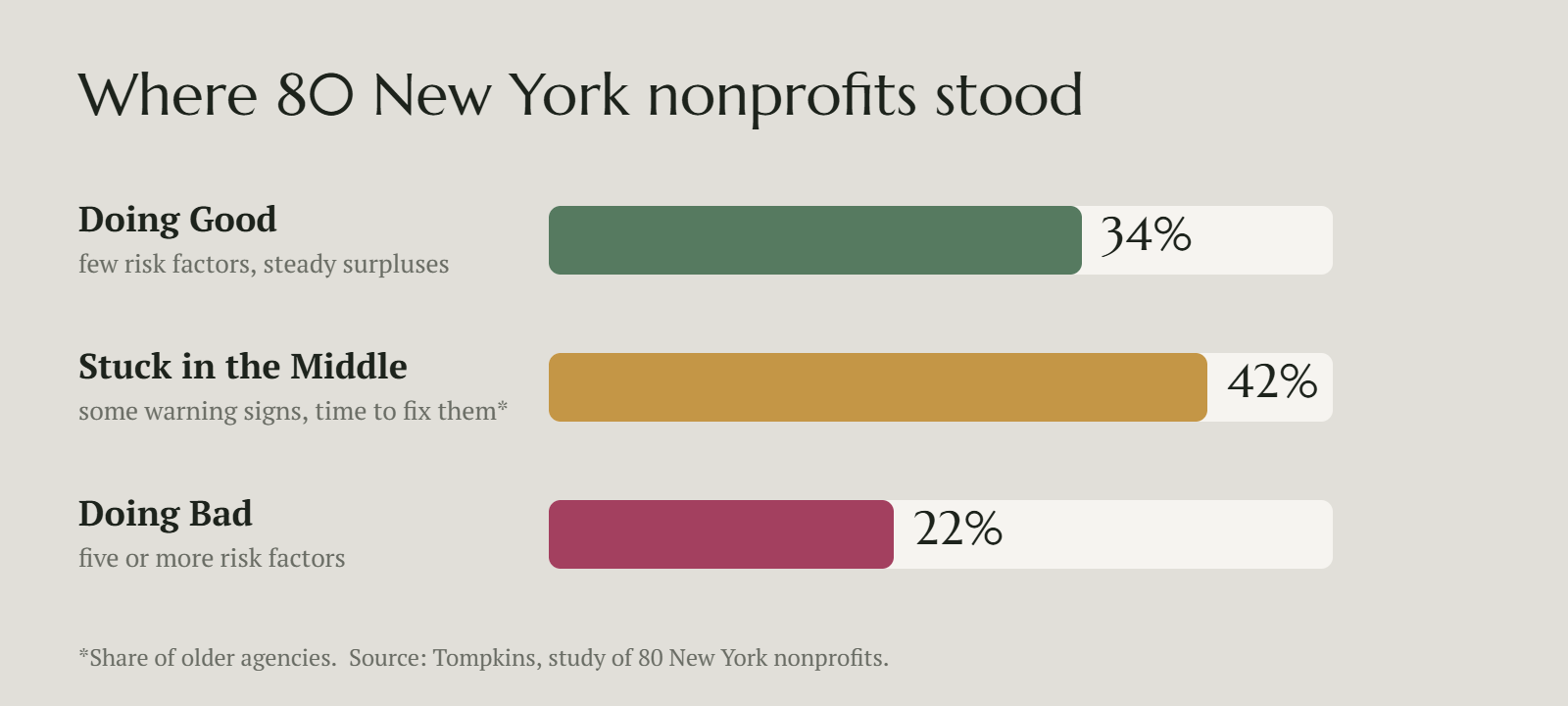
Doing Good (34%): few risk factors, steady surpluses, room to grow.
Stuck in the Middle (42% of older agencies): some warning signs, but time to fix them.
Doing Bad (22%): five or more risk factors, and often a merger or closure ahead.
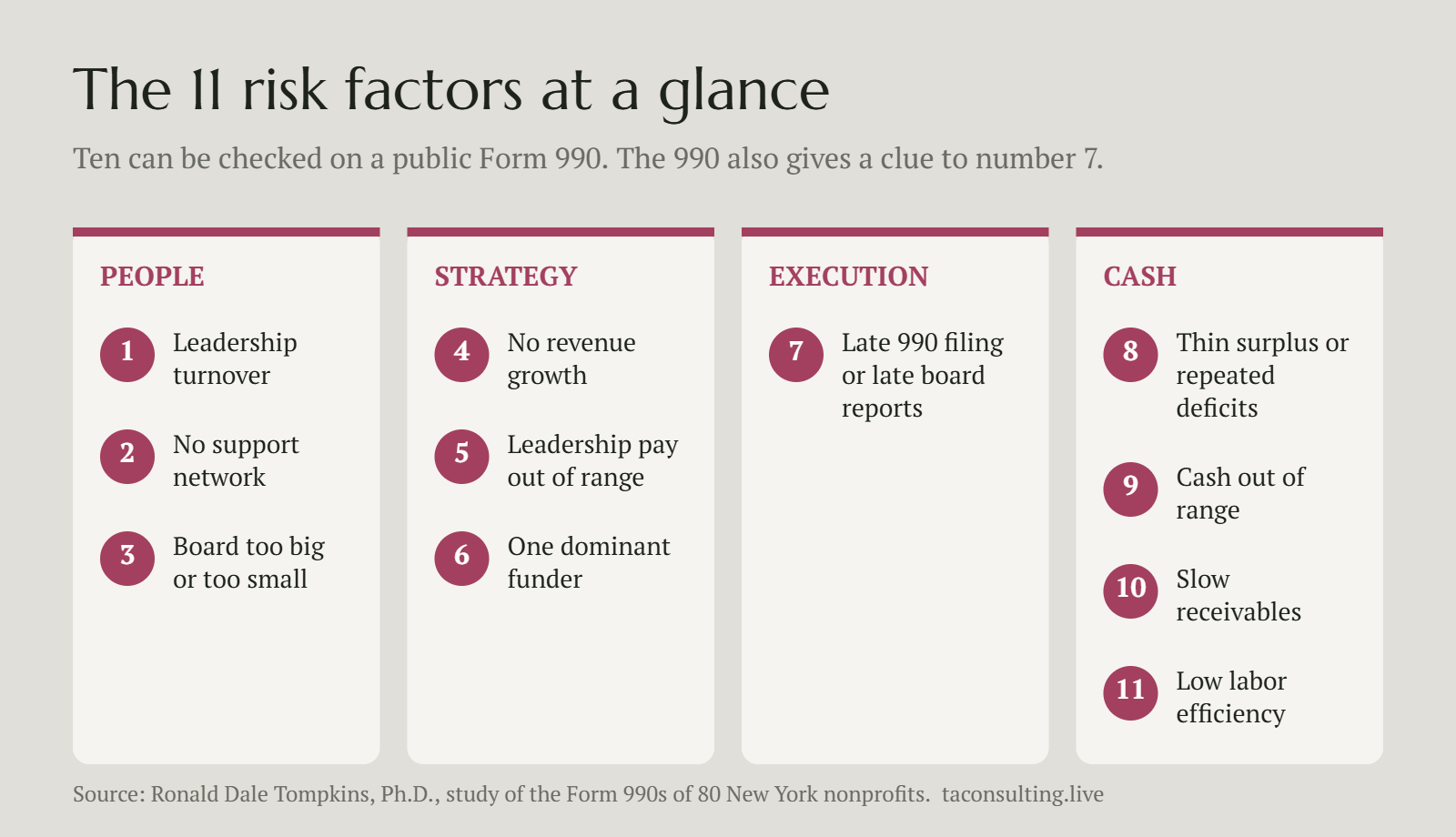
The short answer: the 11 risk factors are (1) leadership turnover, (2) no support network, (3) a board that is too big or too small, (4) no revenue growth, (5) leadership pay out of range, (6) one dominant funder, (7) flawed execution, (8) a thin surplus or repeated deficits, (9) cash out of range, (10) slow receivables and (11) low labor efficiency. They fall into four groups: People, Strategy, Execution and Cash.
People: factors 1 to 3
Most turnarounds start with people. These three factors show whether the agency has steady leadership and help from outside.
1. Leadership turnover. A new leader needs about five years to have real impact: to bring the staff around to a vision, judge who on the team will add value to the future, and make staff changes without doing too much damage to morale. The warning sign is a CEO or board chair in the role under five years, and it is serious when the agency has had three or more CEOs in five years. Where to look: the names in Part VII, Section A, compared across years.
2. No support network. Agencies that stand alone have no one to lend staff, cash or advice in a crisis. The warning sign is no related organization, federation or coalition. Where to look: Schedule R and Schedule O.
3. A board that is too big or too small. A board under 9 members cannot cover finance, fundraising and governance. One over 30 cannot decide quickly. Where to look: Part VI, line 1a.
“A new leader needs about five years to have real impact.”
Strategy and execution: factors 4 to 7
These factors show whether the agency's plan matches its money, and whether the board sees the numbers in time to act.
4. No growth. Costs rise every year. An agency with flat or falling revenue for three years is shrinking in real terms. Where to look: Part I, line 12, over three years.
5. Leadership pay out of range. Leadership pay under 5% of total compensation often means the agency cannot keep strong leaders. Over 20% means too little is left for the staff who deliver programs. Where to look: Part VII, line 1d, divided by Part I, line 15.
6. One dominant funder. When one source pays for nearly everything, one lost contract can close the agency. The warning sign is a second-largest source under 30% of revenue. It is serious when there is only one source. This risk is high for immigrant, refugee and civil rights groups that rely on government contracts. Where to look: Part VIII, lines 1a to 1f and line 2.
7. Flawed execution. Most of this factor lives inside the agency, but the 990 gives one clue: whether it was filed on time. The return is due four and a half months after the fiscal year ends, or ten and a half months with the automatic extension. A 990 filed late often means the books close late, and the board sees financial reports late, or not every month. Where to look: the date the return was signed (Part II) compared with the fiscal year end. Then ask the CFO how soon after month-end the board sees the numbers.
“When one source pays for nearly everything, one lost contract can close the agency.”
Cash: factors 8 to 11
Cash is where trouble becomes visible. These four factors show whether the agency can pay its people next month and next year.
8. A thin surplus. A surplus under 5% of revenue leaves no cushion for a late payment or a cut grant. Deficits three years running are the clearest single sign of an agency in decline. Where to look: Part I, line 19, divided by line 12.
9. Cash out of range. Divide total salaries by 26 to get one two-week payroll. Under 4 payrolls of cash is dangerous, and a payroll paid late is serious. More than 3 years of operations in cash may mean money that should be serving clients. Where to look: Part X, lines 1 and 2, divided by (Part I, line 15 ÷ 26).
10. Slow receivables. Money owed to the agency is not money it can spend. Receivables of 20% of revenue or more often mean slow government payments. Where to look: Part X, lines 3 and 4, divided by Part I, line 12.
11. Low labor efficiency. Revenue should be at least $2 for every $1 of pay. Under 2.0 means salaries are crowding out everything else, and under 1.5 is serious. Where to look: Part I, line 12, divided by line 15.
Where to start, and how to check your agency
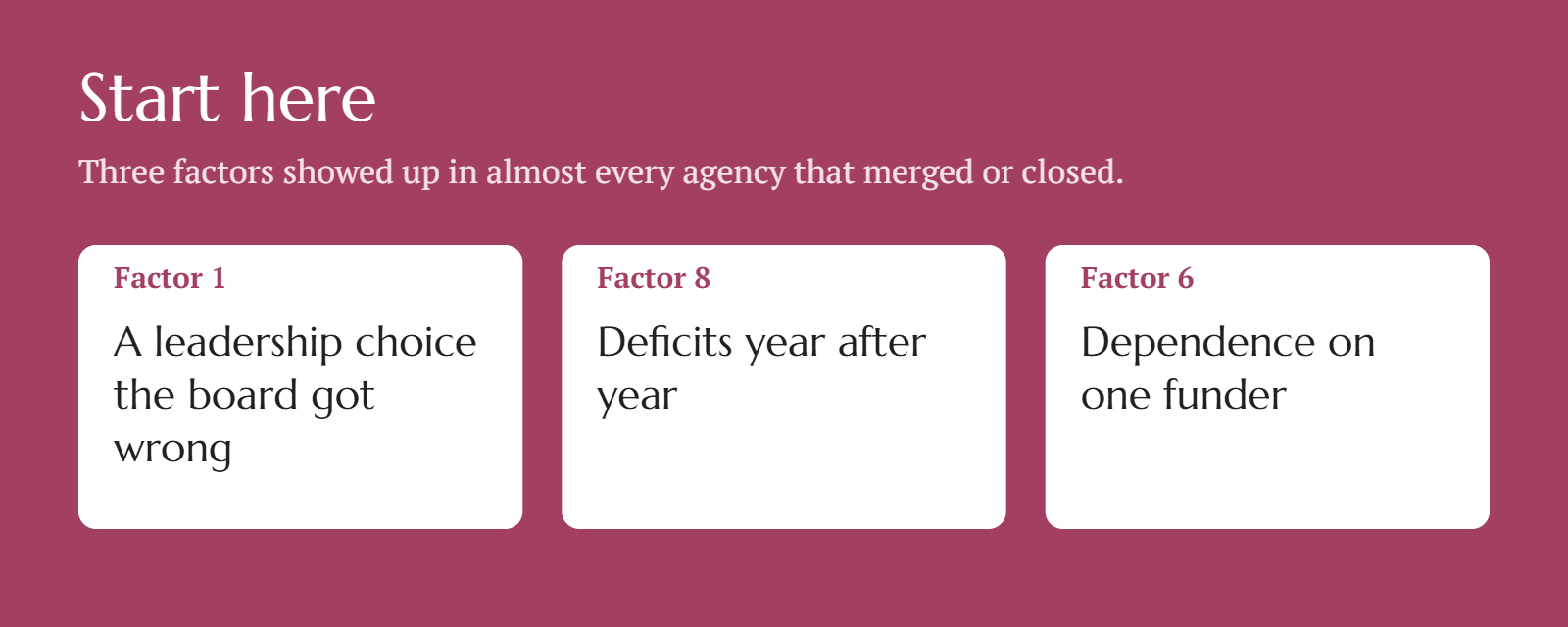
If your agency shows any of these three, start there.
You can check your own agency today:
Find it on ProPublica Nonprofit Explorer. It's free.
Open the three most recent Form 990 filings.
Go through the 11 factors above and count how many apply.
For the scorecard with points, score bands and what to do at each level, download the free 11 Risk Factors Self-Check at taconsulting.live. Board members can also use it before joining a board, taking a job or making a large gift.
The self-check reads public data that is often a year old. It is a screen, not an audit.
Questions boards ask
What is a Form 990? It is the annual return most US nonprofits file with the IRS. It is public, and it shows revenue, expenses, pay, cash, board size and leadership names.
Where can I find my agency's 990? Free on ProPublica Nonprofit Explorer, Candid (GuideStar) or the IRS website. Filings usually appear several months after the fiscal year ends.
How many risk factors is too many? Zero to two is healthy. Three or four means the board should get an outside review. Five or more means acting this month.
Does this apply to immigrant, refugee, civil rights and LGBTQIA organizations? Yes, and these groups should watch factors 6 and 10 closely. Many depend on government contracts that can be cut or paid late.
What if we want a second opinion? A Form 990 Diagnostic scores five years of your 990s against these 11 factors and 7 areas of financial health. It includes a confidential written report and a one-hour review.